Category: Meditation

  • The 8 Limbs of Yoga (Patañjali’s Aṣṭāṅga) Explained

    The 8 Limbs of Yoga (Patañjali’s Aṣṭāṅga) Explained

    The 8 Limbs of Yoga (Patañjali’s Aṣṭāṅga) Explained

    Group sitting in silence on the shore of a forest-ringed lake in the Navarrese Pyrenees, eyes closed

    The 8 limbs of yoga are yama, niyama, āsana, prāṇāyāma, pratyāhāra, dhāraṇā, dhyāna and samādhi. This is the path Patañjali sets out in the Yoga Sūtras under the name aṣṭāṅga yoga (often written “ashtanga”), which literally means “eight-limbed yoga”. The limbs run from the most visible, how you treat others and yourself, to the most subtle, how your mind pays attention. Postures are only one of the eight.

    This guide takes each limb in turn: what it teaches, how it shows up on an ordinary Tuesday, and what psychology has to say about it today. At the end you will find a guided practice for the limb that, in my experience, is the least understood. If you would like the background on the text and its author first, start with who Patañjali was and what the Yoga Sūtras are.

    Eight limbs, not eight rungs

    People often say “the eight steps”, but the Sanskrit word is aṅga: limb, branch. Aṣṭa is eight. Patañjali’s image is not a ladder where you leave one rung behind as you climb to the next. It is a body with eight limbs, or a tree whose branches grow at the same time. Nobody finishes ethics and then starts breathing.

    The order still makes sense. The eight limbs are listed in sūtra 2.29, and the sūtra before it explains what they are for: through their practice, impurities diminish and clarity grows until discernment becomes possible. The first five work on conduct, body, breath and the senses. The last three are, in the text’s own words, “internal” compared with the others: they happen in attention.

    One fact tends to surprise people. Of the 196 sūtras, Patañjali gives exactly three to posture. The yoga we know from photographs is a small part of the map.

    Patañjali’s aṣṭāṅga and Ashtanga Vinyasa are not the same thing

    If you have searched for “ashtanga yoga”, you have probably found demanding classes built on fixed series of postures linked by the breath. That is Ashtanga Vinyasa, the method K. Pattabhi Jois systematised in Mysore in the twentieth century. It borrowed Patañjali’s term, but it is a style of physical practice, not the eight limbs.

    I know both houses. I trained in the Sivananda tradition and have also been a student of Sharath Jois, and I respect both. The distinction matters for a practical reason. If Ashtanga Vinyasa feels too intense for your body or your stage of life, that does not shut you out of Patañjali’s aṣṭāṅga. The eight limbs can be walked at any age and in any body.

    The 8 limbs of yoga, one by one

    1. Yama: how you relate to others

    The yamas are five ethical commitments (sūtra 2.30): ahiṃsā, non-harming; satya, truthfulness; asteya, not taking what is not yours; brahmacarya, the conscious use of energy; and aparigraha, non-hoarding. Patañjali does not begin here out of moralism. It is a psychological observation: a mind that lies, harms or covets has a great deal of noise to manage, and that noise sits down with you when you meditate.

    Ahiṃsā, for example, is not only decided in grand gestures. It is decided in the tone of your reply to a message on a bad day, and in how you speak to yourself when you get something wrong.

    2. Niyama: how you relate to yourself

    The niyamas are five personal disciplines (sūtra 2.32): śauca, cleanliness; saṃtoṣa, contentment; tapas, the steady effort that tempers; svādhyāya, self-study; and īśvara-praṇidhāna, surrender to something greater than the self. Saṃtoṣa may be the most countercultural of them. It is not resignation. It is no longer making your peace depend on the next thing arriving.

    On our retreats we do not teach yama and niyama from a whiteboard. They are lived in karma yoga, shared and selfless work, and in the attitude each person brings to satsaṅg, the gathering where we share, with the whole saṅgha, the community that forms over those days. Ethics is learned by living together.

    3. Āsana: a steady, comfortable posture

    Patañjali’s definition fits in three words: sthira-sukham āsanam (2.46), posture should be steady and comfortable. He does not say flexible, or advanced, or photogenic. And he adds how it is achieved: by relaxing effort. The original meaning of āsana is “seat”: preparing a body that can remain still without pain or restlessness claiming all your attention.

    That is what we work on in the śālā, the practice room: not how far you go, but where you are moving from.

    4. Prāṇāyāma: the breath as a bridge

    Prāṇa is vital energy and āyāma means extension or regulation. Patañjali describes it as the conscious pause in the flow of inhaling and exhaling (2.49) and credits it with a specific effect: the mind becomes fit for concentration (2.53). Breathing is the one function of the autonomic nervous system that you can also direct at will, which is why it works as a bridge between body and mind.

    If you would like a simple place to begin, the article on yoga for back-to-routine stress walks you through one technique step by step. In Arrieta we practise it in the room and also outdoors.

    5. Pratyāhāra: the hinge

    Pratyāhāra is usually translated as “withdrawal of the senses”, and that is where the misunderstanding begins. Sūtra 2.54 does not speak of shutting anything down. It says that the senses, when they stop latching on to their objects, follow the nature of the mind. Āhāra means food: the point is to stop devouring stimuli, not to stop perceiving.

    It is the hinge between the outer and the inner limbs, and it is the one most needed in a life with a screen in your pocket. I give it a whole section below, along with the guided practice.

    6. Dhāraṇā: holding attention on one point

    Dhāraṇā is fixing the mind in one place (3.1): the breath, a flame, a sound, a tree. It is a deliberate effort, and the mind wanders. Bringing it back is not a failure of the practice. It is the practice. Each return is a repetition, as in any training.

    7. Dhyāna: when attention flows by itself

    Dhyāna, meditation, is what happens when that attention stops being interrupted (3.2). The tradition compares it to oil poured from one vessel to another in an unbroken thread. It helps to be clear here: meditation is not something you “do”. You do dhāraṇā, and dhyāna happens when the conditions are ripe. What we usually call “meditating for twenty minutes” is nearly always twenty minutes of dhāraṇā with a few moments of dhyāna. And that is perfectly fine.

    On retreat we practise dhāraṇā and dhyāna in the room and in the forest. The Irati Forest makes it easy.

    8. Samādhi: Liberation

    Samādhi is the state in which only the object of attention shines and the sense of “I am meditating” falls away (3.3). Patañjali describes several degrees and places liberation at the end, kaivalya, which other traditions call mokṣa.

    On retreats I like to joke that the eighth limb is reserved for anyone who comes back a thousand times. It is a joke. The serious part is this: nobody honest can promise you samādhi in a weekend, or in ten. What can be offered are the conditions for the other seven, and that already changes a life.

    The most common misunderstanding: retreating is not disconnecting

    After more than forty years of practice, if I had to name the limb that is least understood, it would be pratyāhāra. People picture it as closing the windows: blocking your ears, stepping away from the world, switching off the senses. Read that way, yoga looks like an escape.

    My experience is different. The real change does not come when you manage to seal yourself off from the world. It comes when you accept duality and learn to live from there. Patañjali’s philosophy is dualist: it distinguishes puruṣa, the consciousness that observes, from prakṛti, nature, everything that changes, your body and your thoughts included. It does not ask you to destroy one in order to keep the other. It asks you to stop confusing them. I have written about that force in Prakṛti, nature as a healing force.

    Other Indian traditions call that changing world of appearances māyā. Māyā is not there to be denied. It is there to be lived, but with presence and awareness. How that way of seeing darkens, and how it clears, is the subject of Māyā, depression and the path of yoga.

    This is why I often say that a retreat is not for disconnecting. It is for connecting: with your body, with your breath, with the people beside you and with the ground under your feet. Pratyāhāra is not about feeling less. It is about no longer chasing everything you feel.

    What psychology says, and what it doesn’t yet know

    With a background in psychology, I care about how far the evidence really goes. Three notes, each with its limits.

    A scattered mind is a heavy one. In 2010, Killingsworth and Gilbert published a study in Science in which more than two thousand people were asked, at random moments, what they were doing and what they were thinking about. Almost half the time their minds were somewhere else, and at those moments they reported feeling worse. That is roughly what Patañjali calls citta-vṛtti, the fluctuations of the mind, when he defines yoga as their stilling (1.2). The study describes an association. It does not prove which causes which.

    Nature rests attention. Stephen Kaplan’s attention restoration theory proposes that natural settings hold attention without effort, which he calls “soft fascination”, and let directed attention, the kind we spend at work, recover. In 2008, Berman, Jonides and Kaplan reported in Psychological Science that a walk in a natural setting improved performance on an attention task more than a walk through city streets. These are small studies with short-term effects, but they point where the tradition already pointed: it is easier to gather the senses where nothing is shouting for them.

    The whole matters. In 2014, Gard and colleagues proposed in Frontiers in Human Neuroscience a model in which yoga improves self-regulation along two routes: top-down, through intention, ethics and attention, and bottom-up, through the body and the breath. It is a theoretical framework built on earlier studies, not definitive proof, and it seems honest to say so.

    On samādhi, science still has very little to say. There we go on relying on the testimony of those who practise.

    Guided practice: pratyāhāra in nature

    On retreats I do not teach pratyāhāra behind closed doors. I teach it outside, before the beauty and abundance of Mother Earth, Ama Lur, as we say here in Basque. You can do this in a forest, in a park or beside an open window. Allow ten to fifteen minutes.

    1. Stop. Sit or stand with a long spine and loose shoulders. Leave your phone away from your body, on silent.
    2. Take three slow breaths through the nose, lengthening the exhale a little.
    3. Open your hearing. Listen first to the farthest sound, then to the nearest. Do not name the sounds. Let them arrive.
    4. Open your sight. Keep a soft gaze, focused on nothing in particular. Receive light, colour and movement without going out to find them.
    5. Open your skin. Notice the air, the temperature and the weight of your body on the earth.
    6. Watch the gesture of chasing. At some point a sound or a thought will pull at you. Do not fight it. Notice the pull and let it go. That letting go is pratyāhāra.
    7. Close your eyes and ask who is perceiving all of this. Do not look for an answer. Rest for a couple of minutes in the plain fact of perceiving.
    8. Return. Open your eyes slowly and give thanks before you move.

    Notice that you have not switched off a single sense. They have been more awake than at any other point in the day. What has changed is the direction: they have stopped going out after things and started receiving them. With practice, you can take that gesture into a meeting, a family meal or a traffic jam.

    Frequently asked questions

    What are the 8 limbs of yoga?

    Yama (ethics towards others), niyama (personal discipline), āsana (posture), prāṇāyāma (regulation of the breath), pratyāhāra (gathering in of the senses), dhāraṇā (concentration), dhyāna (meditation) and samādhi (absorption). Patañjali lists them in sūtra 2.29 of the Yoga Sūtras.

    Do you have to follow the eight limbs in order?

    Not strictly. The order describes a natural progression from outer to inner, but the limbs are practised together and support one another. Most people come to yoga through postures or breathing, and ethics and meditation mature over time.

    Is Patañjali’s aṣṭāṅga the same as Ashtanga Vinyasa?

    No. Patañjali’s aṣṭāṅga is the complete eight-limbed path described in the Yoga Sūtras. Ashtanga Vinyasa is a modern style of physical practice, with fixed series of postures, that took its name from it.

    How long does it take to reach samādhi?

    Nobody can honestly say, and it is wise to be wary of anyone who gives a timescale. The tradition speaks of practice sustained for a long time, without interruption and with dedication. The other seven limbs bear fruit much sooner: more calm, more clarity and a kinder relationship with your own mind.

    To keep walking

    The eight limbs are not a syllabus to pass. They are a way of living that is refined over time, and each person enters by the nearest door. You can begin today with the practice above, ten minutes, wherever you are.

    And if you would like to live the eight limbs together for a few days, with the practice room, the forest and a group to walk alongside you, we would be glad to welcome you at Casa Marterena, a thirteenth-century palace in Arrieta, in the Navarrese Pyrenees, near Pamplona. See the dates of our upcoming yoga and meditation retreats.

  • Yoga for Back-to-Routine Stress: A Step-by-Step Guide

    Yoga for Back-to-Routine Stress: A Step-by-Step Guide

    Yoga for Back-to-Routine Stress: A Step-by-Step Guide

    Autumn beech forest with a carpet of russet leaves, a swollen river and a small waterfall behind, in the Navarrese Pyrenees

    If September has brought back that tight feeling in your chest, a mind looping through overdue tasks, and some trouble falling asleep, you’re far from alone: this experience is widely recognised around the world, often called the “post-vacation blues” or “back-to-routine stress”. Yoga for back-to-routine stress isn’t a September trend: it’s a set of psychophysiological tools — conscious breathing, movement, attention — backed by real science to calm a nervous system that has suddenly started reading your calendar as a threat. In this article, you’ll find out why this happens, and you’ll be guided, step by step, through a breathing technique you can practise today, wherever you are.

    Why the return to routine hits the body, not just the mind

    The first thing worth knowing — something I often repeat during retreats, drawing on my background in psychology — is that what you’re feeling isn’t weakness or poor planning: it’s physiology. Three decades ago, psychologist Daniel Goleman described a mechanism that explains these early-autumn days very well: the amygdala hijack. The amygdala, the brain structure that scans the environment for threats, can trigger a stress response — a racing pulse, muscle tension, irritability — before the prefrontal cortex, the rational part of the brain, has had time to assess whether the danger is real, or whether it’s simply forty unread emails.

    Moving from a relaxed pace to a structured, demanding schedule is, for the nervous system, an abrupt change. In Spain, where our retreat centre is based, up to 30% of workers go through this adjustment reaction every year when they return from holiday, according to the Spanish Society of Family and Community Medicine (semfyc) — a figure that gives a sense of just how widespread this is, and it maps closely onto what’s described internationally as the post-vacation blues. Tiredness, low mood, irritability, lack of motivation, and sometimes anxiety are the most commonly reported symptoms. The good news is that there’s a direct route into that nervous system that doesn’t depend on “thinking positive”: the breath.

    What the science says: breathing, cortisol and attention

    This is where yogic tradition and modern research meet — and it’s what interests me most after more than 40 years of practising and teaching. Slow, diaphragmatic breathing — the kind that expands the belly rather than lifting the shoulders — stimulates the vagus nerve, the main communication channel between body and brain, and activates the parasympathetic “rest and digest” response that counterbalances the sympathetic alarm of an amygdala hijack.

    This isn’t an empty promise. A 2017 study published in Frontiers in Psychology (Ma et al.) assigned 40 healthy adults to either a diaphragmatic breathing training group or a control group. After 20 sessions over 8 weeks, practising at a rate of roughly 4 breaths per minute, the trained group showed a significant decrease in negative affect, a significant improvement in sustained attention, and — most relevant for the back-to-routine season — significantly lower cortisol than the control group, which showed no change. A 2019 quantitative systematic review confirmed the same pattern when it pooled the available studies on diaphragmatic breathing and stress in adults: consistent reductions in physiological and psychological stress markers, though the authors themselves note that protocol quality and duration vary considerably across studies, and that more long-term follow-up trials are needed. In short: it works, and we understand more each year about why, but it isn’t an instant fix — it’s a practice you train.

    The technique: Sama Vritti Pranayama (equal-ratio breathing)

    In Sanskrit, sama means “equal” and vritti refers to the pattern or fluctuation of the breath: it is, literally, equal-ratio breathing — one of the most accessible techniques in all of pranayama (the conscious work with breath within yoga), because it requires no prior experience and no particular posture. It combines that even rhythm with the diaphragmatic breathing behind the study above. Here are the steps:

    1. Sit or lie down comfortably. A chair, the floor, or bed all work, with the spine relatively upright if you’re sitting.
    2. Place one hand on your belly and one on your chest. This simple gesture gives you instant feedback: on the inhale, the hand on your belly should move more than the one on your chest.
    3. Inhale through the nose for a count of 4, letting the belly expand like a balloon, without forcing it.
    4. Exhale through the nose for a count of 4, feeling the belly fall naturally.
    5. Repeat for 5 to 10 minutes. If it feels comfortable, you can extend the count to 5 or 6 on both phases, always keeping the inhale and exhale the same length.
    6. If the mind wanders, come back to counting. That’s not a failure — it’s literally the training itself. Every time you notice a distraction and return to counting, you’re strengthening the same attention the study above found improved.

    The best time to practise this in September is right after waking, before checking your phone, and again just before a moment you know will be tense — a meeting, the kids’ first day back at school, the commute. Five minutes is enough to start noticing a difference; consistency, more than the length of any single session, is what consolidates the effect on cortisol over the medium term.

    Fitting it into a real routine, not an ideal one

    You don’t need an hour of silent meditation for this to work — expecting that is, in fact, one of the most common reasons people abandon the practice by the second week of September. It’s enough to anchor the breathing to something you already do: waiting for your coffee, the first few minutes in the car before you drive off, the five minutes between meetings. Pairing it with a couple of gentle chest-opening and twisting poses — which release the physical tension that builds up in the shoulders and back after weeks at a desk or travelling — reinforces the effect. And if this September calls for more than five minutes a day, a few days of real disconnection, in silence and in nature, are often what allows the nervous system to fully reset before returning to routine, instead of carrying it through the whole autumn.

    Frequently asked questions

    How long does it take to notice the effect of conscious breathing?

    Subjectively, many people notice lower activation — a slower pulse, a less clenched jaw — within the first few-minute session. The measurable effect on cortisol and sustained attention, as in the study cited above, was observed after several weeks of regular practice. It’s both an immediate relief tool and a medium-term training method.

    Is back-to-routine stress the same as anxiety?

    Not exactly, though the two share a mechanism. Back-to-routine stress is generally described as a temporary adjustment reaction to a change of pace, while anxiety can persist without a clear external cause and affect day-to-day life more deeply. If breathing techniques and a few weeks aren’t enough and the distress is interfering with your daily life, it’s worth seeking professional support.

    Can I practise yoga for stress with no prior experience?

    Yes. The breathing technique in this article requires no yoga background, and you can start practising it right now, wherever you’re sitting. It’s usually the easiest entry point into the rest of the practice.

    To keep taking care of yourself this season

    If this back-to-routine season calls for more than a breathing technique, our article How Yoga Helps Reduce High Cortisol and Chronic Stress goes deeper into the cortisol connection this piece only touched on. And if you’d like short practices and content from Retiros Yoga Pirineo sent straight to your inbox, the newsletter sign-up form is at the bottom of this page.

    And if this autumn calls for more than five minutes a day — a real pause, in silence, surrounded by nature — we’ll be here for you at Casa Marterena, our 13th-century palace in the Navarrese Pyrenees, in northern Spain. Sometimes the best way back into your routine is to step out of it for a few days first.

  • A Shift in Perception: How Meditation Transforms Our World

    A Shift in Perception: How Meditation Transforms Our World

    A Shift in Perception: How Meditation Transforms Our World

    From Exhaustion to Compassion: The Journey Within


    This past August, within the thick stone walls of our thirteenth-century home in the Pyrenees—a single breath away from the ancient Irati Forest—two women arrived carrying a weight they had almost stopped noticing they were carrying.

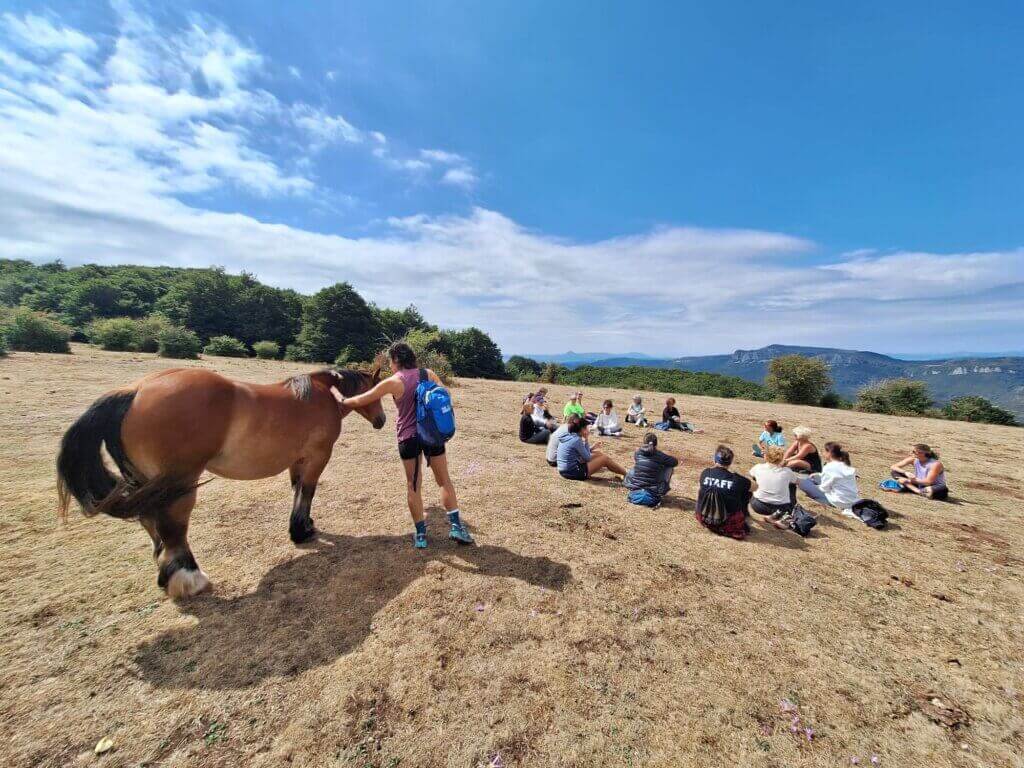
    A bright outdoor scene on a mountain plateau where a woman interacts with a brown horse in the foreground, and retreat participants sit in a mindfulness circle.

    They came to us the way so many do: capable, articulate, admirably competent at holding their lives together. And they came identifying, without hesitation, as perfectionists. Their days were governed by relentless, tightly packed agendas, and beneath that impressive surface ran a current of quiet, private suffering. Not the loud kind that announces itself, but the slow kind—a profound exhaustion that had learned to disguise itself as ordinary unhappiness. They missed their families even while standing in the same room as them. They had, in the truest sense, lost contact with themselves.

    Over our days together, something began to soften. They encountered the raw, unguarded power of genuine metta—loving-kindness meditation. Not the version we sometimes imagine, where we recite pleasant phrases and feel vaguely warmer. The real thing: the kind that reaches past the defenses we have spent years constructing and touches the tender, tired heart underneath. Tears were shed. And out of those tears rose a quiet, luminous realization.

    Both women spoke of wanting to go home and truly try again—to heal their marriages, guided not by obligation or fear but by a newly awakened compassion, and by a wish to spare their children the suffering of a family coming apart.

    My path is not that of a couples counselor, and I would never presume to occupy that role. But my background in psychology, together with four decades of Sadhana, has shown me the same truth again and again: when we turn inward, our outer world does not stay the same. The circumstances of our lives may look identical from the outside, and yet everything has changed—because the one perceiving them has changed.

    The Illusion of Perfection

    Perfectionism rarely feels like a problem from the inside. It feels like standards. It feels like caring, like responsibility, like being the person everyone can rely on. This is precisely what makes it so difficult to see, and so exhausting to carry.

    When we are trapped in an endless cycle of doing, our perception narrows without our noticing. The aperture through which we view our lives tightens until we can only see what is unfinished, what is imperfect, what still needs fixing. And once that lens is in place, we turn it on everything—our partners, our children, and, most mercilessly, ourselves.

    The mind becomes a strict and tireless manager, demanding a flawlessness that no human being could ever supply. Chronic exhaustion settles into the body and quietly distorts how we perceive the people closest to us; the very ones we love most become, in our depleted vision, a series of shortcomings and disappointments. And somewhere along the way, we lose touch with the soft, empathetic, intuitive core of who we are—the part that once knew how to simply be with the people we love, without an agenda, without a correction waiting on our lips.

    This is the great sorrow hidden inside perfectionism. It convinces us that if we could only get everything right, we would finally be at peace. But the goalposts move endlessly, and the peace never arrives. What arrives instead is fatigue, disconnection, and a home life increasingly experienced through a haze of unmet expectations.

    How Deep Sadhana Changes the Lens

    Here I want to be honest, because honesty is its own form of kindness. Entering deeply into Sadhana does not magically erase the complexities of domestic life. It does not mend a struggling marriage on our behalf, resolve old wounds while we sleep, or hand us a partner transformed into someone easier to love. Anyone promising such things is not describing meditation; they are selling a fantasy.

    What Sadhana does is quieter and far more powerful. It changes the person who is living those challenges.

    Metta meditation, in particular, works on the rigid, defensive architecture of perfectionism—the walls we built to keep ourselves safe, which over time became the walls that kept us alone. Sustained loving-kindness begins, gently and without force, to melt them. And as they melt, three shifts tend to emerge.

    The gaze softens. Through the steady practice of loving-kindness, we begin to look at our partners differently. Not as failing projects to be managed or improved, but as fellow human beings—tired in the same way we are tired, overwhelmed in the same way we are overwhelmed, and reaching, however clumsily, for the same connection we ourselves are reaching for. The person across the breakfast table stops being a problem to solve and becomes, once again, someone to meet.

    The agenda releases. So much of our suffering comes not from our lives but from the exhausting gap between how they are and how we have decided they “should” be. Sadhana loosens our grip on that imagined timeline—the schedule of milestones, the picture of the family we were supposed to have by now. As the grip loosens, something remarkable becomes visible: the actual life in front of us, in all its imperfect, unrepeatable beauty. We stop grieving the family we planned and start seeing the family we have.

    Empathy overflows. This is perhaps the deepest movement of all, and it begins in an unexpected place—with ourselves. As we sit in meditation and finally extend a little grace to our own internal suffering, that grace does not stay contained. It cannot. Compassion, once it is genuinely felt, has a way of spilling outward. The tenderness we offer our own tired hearts becomes the tenderness we can offer a spouse, a child, a struggling friend. We give to others out of the fullness we have first learned to give to ourselves.

    Loving-Kindness Begins at Home—Within Us

    There is an old and wise sequence at the heart of metta practice, and it is worth understanding why it unfolds the way it does. We do not begin by sending love out to the difficult people in our lives. We begin with ourselves.

    For a perfectionist, this can be the hardest instruction imaginable. May I be well. May I be happy. May I be at peace. The words can feel almost impossible to say and mean, because the perfectionist has spent a lifetime believing that peace must be earned, that rest must be deserved, that kindness toward oneself is a form of laziness or self-indulgence.

    And yet this is exactly where the healing must start. We cannot pour from an empty cup. A woman who has never once shown herself compassion has no reservoir of it to draw upon when her husband is short-tempered or her child is difficult. She will meet their imperfections with the same harshness she has long turned on her own. But the woman who has begun, even tentatively, to hold herself with warmth discovers that she has something to give—and that giving it no longer depletes her.

    This is why the shift the two women experienced in August was not, at its root, about their marriages at all. It was about the return of a certain softness to their own hearts. The desire to go home and try again was not a resignation or a duty grimly accepted. It was the natural expression of a perception that had opened. When we finally see our partners and children with clear, unhurried, compassionate eyes, the wish to protect what we share with them arises on its own.

    I want to be equally clear about something, precisely because I hold this practice in such reverence. Loving-kindness is never self-erasure. Metta that includes everyone but ourselves is not metta at all. The clarity that meditation brings is genuine clarity—it helps us see what is worth healing, and it also helps us see honestly when something has become harmful. The goal is never to talk ourselves into staying anywhere at any cost. The goal is to make our decisions from a place of open-hearted awareness rather than from exhaustion, fear, or the frantic momentum of a mind that never stops. For these two women, that clear seeing led them lovingly back toward their families. For another person, clarity might lead somewhere else entirely. What matters is that the choice arises from a settled, compassionate heart rather than a depleted one.

    The Quiet Sanctuary of the Mountains

    There is a reason we do this work here, in these old stone rooms, surrounded by the forest and the silence of the Pyrenees.

    When we finally pause the relentless doing—when we allow ourselves simply to breathe within a place that has stood quietly for eight hundred years—the frantic mind begins, at last, to settle. The mountains do not hurry. The forest keeps no agenda. And in their company, something in us remembers that we do not have to either.

    The psychological shift that occurs in Sadhana is not an escape from our lives. It is a homecoming to them. It allows us to return to our families, our responsibilities, and our ordinary days carrying not a list of demands but an open, resilient heart. Nothing in the outer circumstances may have changed. And yet the whole world looks different, because we are looking through different eyes.

    This is the quiet revolution that meditation offers. It does not rearrange our lives from the outside. It transforms the one who is living them—and from that single, inward change, everything else begins, gently, to shift.

    If you feel the weight of a life lived at full speed, if you sense that somewhere beneath the exhaustion there is a softer self waiting to be met again, know that the door back to that self is always open. Sometimes it takes only stillness, a little kindness turned inward, and the ancient patience of the mountains to help us find it.

    With warmth, from Casa Marterena and the Irati Forest

  • The Art of Being Nobody: How Your Identity Steals Your Energy (And How the Observer Sets You Free)

    The Art of Being Nobody: How Your Identity Steals Your Energy (And How the Observer Sets You Free)

    The Art of Being Nobody: How Your Identity Steals Your Energy (And How the Observer Sets You Free)

    A vertical photograph captures a clear, peaceful stream gently descending over a path of deep-green, moss-covered rocks. The stream flows through a dense forest with tall, leafy trees. In the foreground, large, delicate green ferns frame the water. The overall atmosphere is shaded, cool, serene, and untouched.

    There is a concept I discovered while watching a series many years ago. A deeply intriguing concept.

    The concept of being “Nobody.”

    In the story, those undergoing a sacred training had to completely strip away their identity and their personal history. To become Nobody, they had to lay down their names, their family ties, their past wounds, and even their deepest desires for vengeance or validation.

    They surrendered absolutely everything. Because a “somebody” cannot be nobody. And in that space, “Nobody” was the only correct answer.

    It makes you reflect. In our modern daily lives, we do the exact opposite. We cling with all our might to the identity we have meticulously constructed—or the one society helped build for us. We spend decades sculpting a persona, feeding what we think we are, or carefully guarding the exact image we want the world to see.

    We carry our status, our professional titles, the role of the “reliable one,” the “perfect parent,” or the “unstoppable leader.”

    But when you allow yourself, even for a single moment, to become Nobody… you finally drop the weight.

    The Energetic Cost of “Having to Be”

    We live in a culture obsessed with hyper-identification. From the moment we wake up to the moment we sleep, we are pushed to reinforce the “I.” Modern life demands that we have an opinion on everything, define our personal brand, and fit neatly into predictable boxes.

    For a mind already managed by a relentless agenda, this creates an invisible, devastating exhaustion. Maintaining an identity consumes an immense amount of vital life force.

    Think of it like an actor on a stage:

    • It is one thing to step into the spotlight, play a demanding role for a few hours, and then leave the costume in the dressing room.
    • It is an entirely different—and exhausting—tragedy to walk home with the heavy armor still on, sleep in it, and demand that your family treat you as the character 24 hours a day.

    Yet, this is exactly what we do when we over-identify with our roles. The stressed professional who cannot turn off their mental laptop during dinner isn’t just suffering from a heavy workload; they are suffering from an attachment to their identity as the indispensable one.

    When you rigidly define yourself, you instantly limit your potential. Saying “I am just an anxious person” or “This is just who I am at my age” builds walls around your consciousness. You lock yourself inside a prison built from the concepts of your past.

    Every time you force yourself to act according to the label you’ve accepted, you waste energy sustaining a facade rather than flowing with life. It is the crushing weight of over-scheduled days, external expectations, and self-imposed deadlines. A weight carried so normally that we forget what it feels like to walk light.

    And the truth remains absolute: baggage is still baggage, no matter how beautiful or successful it looks.

    Sadhana and Awakening the Observer

    I do not know if it is possible in this modern world to permanently become “Nobody”. After all, we need a name for a bank account and certain roles to navigate society. The goal is not a state of amnesia, but rather transforming our relationship with the character we play.

    How do we achieve this without fleeing to a remote cave? Through the practice of yoga and meditation.

    Meditation is not an exercise in forcing the mind blank, nor is it a passive escape from reality. It is the most refined practice available to awaken the Observer.

    When you sit in silence, close your eyes, and simply anchor your awareness to the natural rhythm of your breath, something extraordinary happens to your inner landscape. At first, the mind leaps erratically—recalling a pending email, reliving yesterday’s friction, or projecting anxiety onto the future.

    Without practice, you hook into these thoughts. You become them. If a stressful thought arises, you become the stress. Your chest tightens, your heart rate rises, and your energy drains.

    However, as your practice deepens, a subtle, revolutionary gap opens between the thought and you. You realize a fundamental truth:

    If you are capable of watching the thought pass by, you cannot be the thought. You are the space in which the thought occurs.

    This is the awakening of the Silent Observer. The witness consciousness.

    The Observer does not judge the thought as good or bad. It doesn’t try to grasp pleasant memories or push away uncomfortable ones. It simply watches. It is like the vast sky witnessing the weather: whether dark storm clouds pass or light mists drift, the sky remains inherently untouched, luminous, and spacious.

    By training yourself to rest as the Observer, you discover that your emotions, your fears, your career titles, and your past mistakes are merely clouds crossing the sky of your awareness. They belong to the character, but they are not You. As you disentangle from the mind, the heavy persona loses its grip, physical tension dissolves, and the energy once spent defending your image is instantly reclaimed.

    When You Are “Nobody,” You Are “Everything”

    Here lies the most beautiful paradox of the inner journey: when you become Nobody, you open yourself to being Everything.

    When you renounce the obsession with defining yourself, you shatter the boundaries of separation. If you identify strictly as a “successful 45-year-old executive,” you automatically exclude yourself from everything that doesn’t fit into that sentence. You separate yourself from the rustle of the leaves, the peace of the earth, and your own infinite capacity to reinvent yourself tomorrow morning.

    Identification fragments reality. It creates “me” versus “them,” “mine” versus “yours.” And within that separation, all internal suffering and anxiety are born.

    Conversely, when the Observer stabilizes and you experience the stillness of being “Nobody,” the borders of the ego soften. You realize that life is not happening to you—life is expressing itself through you. You no longer need to defend a tiny plot of identity against the rest of the universe.

    You stop being the wave caught in its own form, obsessed with being taller, faster, or prettier than the other waves, and you remember that you are the entire ocean. The individual wave will inevitably alter its shape at the shore, but the water itself remains free, deep, and unshakeable.

    To be Nobody is not to become empty and helpless; it is to empty yourself of what is artificial so you can be filled with what is True. It is reclaiming the infinite potential that existed before the world told you who you “had to be” to deserve respect.

    An Invitation to Drop the Luggage

    Examining our attachment to our identities is not an academic philosophy. It is an urgent requirement for mental and spiritual sanity for anyone who feels life slipping away between calendar alerts, performance metrics, and a quiet unhappiness that material success cannot soothe.

    It means looking honestly at your current exhaustion and realizing it might not be a lack of physical sleep, but the chronic fatigue of wearing a mask that has grown too tight.

    Sometimes, healing does not require adding anything more to your to-do list. You do not need another course, another achievement, or another skill to master. What you need is subtraction. Unlearning. Leaving your heavy luggage at the door and stepping into a sacred space where you have nothing to prove to anyone. Not even to yourself.

    Yesterday, I was walking along the mountain path with Thor, moving slowly through a trail lined with boxwoods, ancient oaks, and hazels that woven a green canopy over the sky. In the heart of that living silence, where trees simply exist without the slightest worry about their status or identity, I remembered this truth.

    Nature does not care about our names, our tight schedules, or the titles we print on our business cards. The forest embraces you exactly the same whether you are a corporate director or a weary traveler, because to the earth, we are all the same life beating to one pulse.

    Imagine it now: a damp trail, the scent of wild earth, the soft crunch of leaves beneath your feet, and the deep, majestic silence of the Pyrenees. A perfect sanctuary to take a deep breath, let your heavy armor fall to the ground, look at the world through the eyes of the Observer, and remember, with a sigh of absolute relief…

    …how beautifully free it feels to dare to be Nobody.

  • When the Mind Darkens the World: Māyā, Depression and the Path of Yoga

    When the Mind Darkens the World: Māyā, Depression and the Path of Yoga

    When the Mind Darkens the World: Māyā, Depression and the Path of Yoga

    There are days when the world seems to lose its depth.

    Light enters the room, but somehow it does not arrive. Voices sound distant. The things that once gave meaning to the day feel flat, repetitive, almost unreal. Life is still there — trees, sky, breath, a warm cup held between the hands — yet something in the way we see has gone dim.

    Anyone who has passed through deep sadness, emotional exhaustion or a depressive view of life knows that this is not simply a matter of “thinking positively.” That phrase, even when kindly meant, can feel almost violent. Because when the mind is covered by darkness, we cannot change our inner world as easily as we change a thought. The whole field of perception seems coloured. The future narrows. The past grows heavy. The present, instead of becoming a refuge, feels like a room without windows.

    In the yogic tradition, there is an ancient word that can help us understand this without reducing it: Māyā.

    Māyā is often translated as illusion, but that word can be misleading. It does not necessarily mean that the world is false. It points instead to the fact that we rarely see reality as it is. We see through veils: memories, wounds, fears, desires, habits, identities, expectations. The mind does not simply look at the world. It interprets it, colours it, contracts it, sometimes even imprisons it.

    Seen in this way, a depressive view of life is not “the truth,” even when it feels completely true. It is a conditioned way of seeing, an inner fog that makes everything appear more closed, more painful, more inevitable. Pain exists. Loss exists. Exhaustion exists. But the mind, when trapped, adds a silent conclusion: “This will always be like this.” “There is no way out.” “I am what I feel.”

    Yoga begins precisely there: in the possibility of discovering that we are not exactly what the mind tells us we are.

    Māyā in yoga: the veil between life and our interpretation of life

    To speak about Māyā in yoga is not to speak about an exotic abstraction. It is to speak about something deeply human.

    We all live, to some degree, inside stories. We tell ourselves who we are, what we deserve, what we can expect, what our pain means, what our future may hold.

    Sometimes these stories help us. They give shape, direction and continuity to our lives. But at other times, they become a prison.

    A woman who has spent years holding everything together — work, family, care, emotional responsibility, invisible duties, the constant need to be available — may reach a point where her whole system becomes tired. Outwardly, she may still function. She answers messages, prepares meals, solves problems, smiles when needed. Inwardly, however, something begins to close.

    Negative thoughts appear, but they do not feel like thoughts. They feel like facts.

    “I cannot do this anymore.”

    “No one really sees me.”

    “My life has become too small.”

    “I have lost my joy.”

    Māyā does not deny suffering. It does not say that pain is imaginary. Its teaching is more subtle: when we suffer, the mind often turns a temporary experience into a permanent identity.

    “I am tired” becomes “I am incapable.”

    “I feel sad” becomes “My life has no meaning.”

    “I need help” becomes “There is something broken in me.”

    This is where the veil thickens.

    Yoga, when practised deeply, does not shout against the mind. It does not simply say, “You are wrong.” It invites the mind to become quiet enough to be seen. It brings us back to the body, to the breath, to the present moment. It teaches us to observe without believing everything.

    And sometimes, perhaps for the first time in a long while, we discover that there is a space between a thought and the awareness that notices it.

    In that space, freedom can begin.

    Yoga and depression: a relationship that deserves care

    It is important to say this clearly: yoga does not replace medical, psychological or therapeutic support when someone is going through clinical depression or intense emotional suffering. Depression may require professional care, and asking for help is not a spiritual failure. It is an act of wisdom.

    But it is also true that yoga can become a meaningful support on the way back to life.

    Not as a quick promise. Not as a magical solution. Not as another pressure to “feel better.” Rather, yoga can offer a patient, embodied practice that helps rebuild our relationship with the body, breath, attention and inner experience.

    The expression yoga and depression is delicate because it touches a vulnerable place. But perhaps that is exactly why it matters to speak about it with honesty. Many people are not looking for a perfect theory. They are looking for a doorway. Something that allows them, even for a few minutes, to step out of the mental loop where life becomes a repetition of the same painful thoughts.

    Depressive states often narrow attention. The mind returns again and again to what hurts, what is missing, what failed, what might be lost. It is as if the field of the soul becomes smaller. Everything that contradicts the depressive view falls out of focus: beauty, connection, possibility, the living body, the breath moving in and out.

    Yoga works differently. It does not begin by forcing us to think something else. It brings attention first to a more basic experience: feeling the feet, sensing the spine, lengthening the exhale, softening the jaw, listening to the heartbeat.

    This may seem small.

    In truth, it can be enormous.

    A mind trapped in its own darkness often needs to remember that it is not alone inside the head. There is a body. There is breath. There is ground beneath us.

    The body as a way out of the mental labyrinth

    When the mind darkens the world, the body can become a place of return.

    Not because the body is always comfortable. Often, when we stop, we meet exactly what we have been avoiding: tension, fatigue, anxiety, emptiness, tears. But the body has a kind of honesty the mind can lose. It does not build so many arguments. It speaks in sensations.

    A simple yoga posture, held with attention, can reveal a great deal.

    We may discover that the shoulders have been lifted for months.

    That the breath barely reaches the belly.

    That the legs are stronger than the mind believes.

    That the chest has learned to protect itself.

    That sadness is not an abstract cloud, but a pressure, a weight, a way of breathing.

    This discovery is not always pleasant, but it is real. And what is real, even when painful, often liberates more than confusion.

    In the Yoga Sutras, Patañjali speaks of the fluctuations of the mind. Yoga is described as the stilling of these fluctuations — not through repression, but through practice, awareness and understanding. When the mind is highly agitated or deeply dull, we mistake its movements for reality itself. If there is fear, everything looks dangerous. If there is sadness, everything looks lost. If there is guilt, everything seems to accuse us. If there is exhaustion, everything appears impossible.

    Practice teaches us to observe:

    “There is fear.”

    “There is sadness.”

    “There is fatigue.”

    “There is a thought saying I cannot cope.”

    This small shift changes everything. We are no longer completely swallowed by what appears. Something in us begins to witness.

    And the witness is wider than the depression.

    Avidyā: mistaking one part for the whole

    Alongside Māyā, another important yogic concept is Avidyā, often translated as ignorance or misperception. But this is not about intellectual ignorance. A sensitive, intelligent, educated person can still be caught in Avidyā.

    Avidyā means not seeing clearly. It means confusing the changing with the permanent, the partial with the total, a thought with the truth, pain with identity.

    In a depressive view of life, Avidyā may sound like this:

    “Because I feel no joy today, joy no longer exists.”

    “Because I failed at something, I am a failure.”

    “Because I feel alone now, I will always be alone.”

    “Because I have no energy, I have no worth.”

    These inner sentences are not always spoken so clearly. Often they are atmospheres, moods, sensations of destiny. But they act like silent commandments.

    Yoga does not dissolve Avidyā by giving us more information. It dissolves it through direct experience.

    A person may arrive on the mat feeling heavy, closed, uninterested, convinced that nothing will shift. She moves gently. She breathes. She rests. At the end, perhaps she is not joyful. Perhaps she has not solved her life. Perhaps she does not have answers.

    But something has moved.

    There is a little more space. The breath is wider. The face has softened. The mind, even for a moment, is less convinced by its own darkness.

    That moment matters.

    It breaks the hypnosis of “always.” It shows that the inner state can change. And if it can change a little, it can change again.

    Negative thoughts: not fighting them, but no longer obeying them

    Many people try to escape negative thoughts by fighting them. They want to eliminate them, correct them, defeat them.

    But often the fight only strengthens the loop. The mind becomes a battlefield. One part suffers, while another part demands improvement. One part cries, while another gets angry for crying. One part is exhausted, while another accuses it of weakness.

    Yoga offers another way: observation without identification.

    During practice, this becomes very concrete. A thought appears: “I am doing this wrong.” We notice it. We return to the breath.

    Another thought appears: “I am not good at this.” We notice it. We return to the body.

    A comparison, a memory, a worry arises. We do not have to follow it. We do not have to believe it. We do not have to hate it either.

    We simply return.

    This repeated return is a profound form of inner education. Each time we come back to the body, we weaken the automatic habit of following the mind wherever it goes. Each conscious exhalation says, without words: “I do not have to enter every thought that appears.”

    This is especially important when we speak about yoga and mental health. Yoga is not only about beautiful postures or flexibility. In moments of emotional fragility, the most transformative yoga is often the simplest: slow movement, conscious breathing, deep relaxation, guided meditation, walking in silence, kind presence.

    It is not about conquering the body.

    It is about coming home to it.

    Tamas, rajas and sattva: three qualities of the mind

    The yogic tradition also speaks of three qualities, or gunas: tamas, rajas and sattva.

    Tamas is heaviness, inertia, darkness, dullness. When tamas dominates, it is difficult to rise, choose, feel enthusiasm or move toward life.

    Rajas is agitation, restlessness, overactivity, anxiety. When rajas dominates, the mind cannot settle. It jumps from one concern to another.

    Sattva is clarity, balance, harmony, luminosity. It is not artificial happiness, but a transparent quality of mind that allows us to see more clearly.

    In depressive states, there may be a great deal of tamas: heaviness, blockage, lack of energy. But often there is also rajas underneath: rumination, guilt, worry, repetitive thoughts. A person may feel exhausted and yet unable to truly rest. The body feels collapsed, while the mind keeps spinning.

    Yoga helps to move tamas without forcing the system, to calm rajas without suppressing life, and to cultivate sattva gradually.

    This requires sensitivity. A very intense practice may not be appropriate when someone feels emotionally fragile. A practice that is too passive may feed inertia if it is not held with awareness. The real question is not “What is the most impressive practice?” but “What helps this person return to balance today?”

    Sometimes the doorway is gentle breathing.

    Sometimes it is walking.

    Sometimes it is a simple sequence of postures.

    Sometimes it is lying under a blanket and allowing the nervous system to feel safe.

    True yoga does not impose a form. It listens.

    Nature as a teacher of perception

    There are places that help us remember what the mind forgets.

    A forest, for example, does not argue with our thoughts. It does not ask us to be cheerful. It does not demand explanations. It simply is. It breathes in its own way. It grows, decays, renews itself, leans toward light.

    In the nature of the Navarrese Pyrenees, near the Irati Forest, the volume of the mind often begins to soften. Not always immediately. Sometimes we arrive with such inner speed that we no longer know how to look. But little by little, something changes.

    The sound of leaves.

    The smell of earth.

    The shade of old trees.

    The quiet presence of animals.

    Light filtering through branches.

    All of this becomes a silent teaching.

    The image of a donkey standing beneath the green shade of a tree may seem simple. And yet it contains a wisdom the modern mind has almost forgotten. The animal is not trying to become something else. It is not wondering whether its life should be more impressive. It is there, at the edge of the field, breathing inside the day.

    The scene does not solve human suffering. But it reminds us of something essential: life is not limited to our thoughts about life.

    When someone is caught in a depressive view, contact with nature can open small cracks in the mental wall. Not because landscape alone cures suffering, but because it returns us to a reality wider than our narrative. There is wind. There is earth. There are seasons. There are bodies that do not live by constantly explaining themselves. There is a humble intelligence in living things.

    Yoga practised in such a place can become deeper. Breath is no longer an isolated technique; it meets the actual air. Silence is no longer an idea; it can be heard. Posture is no longer an aesthetic shape; it becomes a way of standing on the earth. Meditation is not an escape from the world; it is a return to the world with less fog.

    Breaking the cycle: from “I am this” to “this is happening”

    One of the most painful cycles in a depressive view of life is identification.

    We do not only feel sadness; we believe we are sadness.

    We do not only feel tired; we believe we are incapable.

    We do not only have negative thoughts; we believe they are an accurate description of reality.

    Yoga breaks this cycle very gently. It teaches us to shift the inner language from identity to process.

    Instead of “I am a disaster,” we begin to sense, “There is pain and disorder in me right now.”

    Instead of “There is no way out,” we notice, “My mind cannot see a way out in this moment.”

    Instead of “I am broken,” we feel, “There is a part of me that needs care.”

    This may seem like a small change. It is not. Where there is process, there is movement. Where there is movement, there is possibility.

    Regular practice creates a new intimacy with ourselves. We learn to recognise when the mind closes, when the chest hardens, when the breath becomes short, when the old story begins. Not in order to judge ourselves, but to intervene earlier and more kindly.

    A few minutes of breathing.

    A resting posture.

    A conscious walk.

    An honest conversation.

    A pause before obeying a thought.

    This is how Māyā begins to loosen: not through dramatic revelation, but through repeated acts of clarity.

    Yoga does not promise a life without pain

    It would be false, and even unkind, to present yoga as a path toward a life without sadness. Practice does not make us invulnerable. It does not prevent loss, crisis, farewells or winters of the soul. Sometimes, by making us more sensitive, yoga allows us to feel more honestly what we once kept at a distance.

    But yoga can change our relationship with pain.

    We can learn not to add secondary suffering to unavoidable suffering. Not to turn a difficult emotion into a life sentence. Not to assume that a dark thought has more authority than breath, body, love, daylight or the part of us that still longs to live better.

    The depressive view says, “This is all there is.”

    Yoga answers, very slowly, “Look again.”

    Look again at the body breathing.

    Look again at the ground holding you.

    Look again at the part of you that, tired as it may be, has come this far.

    Look again at the possibility of asking for help.

    Look again at the small gesture that is possible today.

    Look again at the world before believing the mind has described it completely.

    Learning to see again

    Perhaps the deepest purpose of yoga is not to reach an extraordinary experience, but to recover a clearer way of seeing.

    To see without so much projection.

    To feel without so much defence.

    To think without being trapped by every thought.

    To inhabit the body as a home, not as a burden.

    To relate to the mind as an instrument, not as a tyrant.

    Māyā will continue to appear. We all live, in some way, behind veils. But practice helps us recognise them. And the moment we recognise a veil, we are no longer completely inside it.

    This is why yoga can be so valuable for those moving through vital exhaustion, sadness or negative thoughts. Not because it denies darkness, but because it awakens a form of attention that does not belong to the darkness.

    A patient attention.

    A bodily attention.

    A breathing attention.

    An attention that does not demand immediate happiness.

    An attention that stays.

    Sometimes, this is the first medicine: not abandoning ourselves.

    In a yoga and meditation retreat, away from habitual noise, this understanding can become more tangible. Nature, silence, daily practice, nourishing food and gentle guidance create the conditions for the mind to loosen its certainties. There is no need to force transformation. It is enough, sometimes, to create the right conditions for feeling to return.

    And then, perhaps beneath the trees, in a longer breath than usual, something simple and immense occurs:

    Life stops feeling like a closed idea.

    It becomes a presence again.

    Not everything the mind says is true.

    Not everything that hurts today will last forever.

    Not every veil is destiny.

    Sometimes the path begins like this: breathing, looking again, allowing a little light to pass through the leaves.

  • Conscious Movement: Recharge Instead of Exhaust

    Conscious Movement: Recharge Instead of Exhaust

    Conscious Movement: Recharge Instead of Exhaust

    When someone thinks about a yoga and meditation retreat in nature, one of the most common doubts arises:
    “What if I can’t keep up?”

    Maybe you imagine long, demanding days. Intense yoga sessions. Mountain hikes that leave you drained.

    The truth is very different.

    In an authentic retreat, the purpose is not to exhaust you. It is to care for you, to help you listen inwardly, and to allow you to recharge.

    At our Yoga and Meditation Retreats in the Pyrenees, you don’t need special physical conditioning or endless stamina. The only real requirement is your presence — and your willingness to pause and reconnect.

    .

    Conscious Movement: A Different Way of Moving

    In our fast-paced world, we associate movement with burning energy: running, training, rushing from place to place.

    At a retreat, movement becomes something else entirely.

    It’s not about performance.
    It’s not about pushing limits.
    It’s not about proving anything.

    Yoga is not a competition. It becomes a space to feel your body, release tension, and rediscover your breath.

    Our walks and treks are not endurance challenges. They are gentle journeys through landscapes that invite calm and contemplation.

    Conscious movement doesn’t drain you — it energizes you.

    Each stretch.
    Each deep breath.
    Each quiet step in nature.

    All of it helps you put down the invisible weight you’ve been carrying and return to a sense of inner lightness.

    Gentle Trekking in the Pyrenees: Nature That Supports, Not Demands

    One of the greatest gifts of retreating in the Pyrenees is walking through ancient forests, along medieval paths, and beside crystal-clear rivers.

    But forget the image of extreme expeditions.

    We practice gentle trekking:

    • Walks adapted to all levels
    • A slow, mindful pace
    • Pauses to breathe, observe, or meditate
    • Small groups where everyone finds their own rhythm

    The goal isn’t to cover kilometers.
    It’s to allow nature to guide your inner journey.

    A peaceful walk beneath trees can be more healing than hours at the gym — because it integrates body, emotions, and spirit.

    Yoga Without Exhaustion: Less Is More

    Many people assume that retreat yoga means hours of advanced postures and physical strain.

    Not here.

    Our approach is accessible and adaptable:

    • Suitable for beginners and experienced practitioners alike
    • Gentle, progressive sequences
    • Breath-centered movement
    • Options for every body

    You step off the mat feeling lighter, calmer, and more connected — not sore and depleted.

    Here, yoga becomes active rest.
    A soft awakening of the body.
    A gift to your nervous system.

    Active Rest: Generating Energy Instead of Losing It

    Retreat life flows in a natural rhythm between movement and stillness.

    You walk.
    You breathe.
    You stretch.
    And you also rest.

    This balance is the secret.

    Gentle movement releases accumulated tension.
    Conscious rest allows regeneration.
    Together, they create vitality.

    That’s why those who arrive wondering, “Will I be able to keep up?” often leave surprised — discovering they have more energy at the end of the day than when it began.

    Listening to Yourself: The Real Foundation

    An authentic retreat is not about rigid schedules. It’s about inner listening.

    No one pushes you.

    If you need more rest, you take it.
    If you prefer a slower pace, the group adapts.
    If a posture isn’t right for you, alternatives are offered.

    A retreat is an opportunity to honor your body’s signals — something daily life rarely allows.

    And in that listening, something profound begins to heal.

    The Benefits of Moving Without Exhausting Yourself

    Those who experience conscious movement for the first time are often surprised by how powerful gentleness can be.

    After just a few days, many feel:

    • Increased vitality
    • Greater mental clarity
    • Physical and emotional lightness
    • A deeper sense of inner peace
    • Renewed connection with themselves

    A retreat does not squeeze you dry.
    It restores you.

    You return home with a calmer heart, a more flexible body, and a clearer mind.

    From Doubt to Surprise

    Many guests arrive unsure.

    “I’m not athletic,” one participant once said. “I thought I wouldn’t be able to keep up.”

    Two days later, her perspective had shifted completely.

    “I don’t just keep up — I feel lighter and more rested than I have in years.”

    This is something we see again and again.

    Retreats are not for the strongest.
    They are for those who are ready to reconnect.

    The Rhythm Is Yours

    If you’ve ever wondered:

    Will the trekking be too demanding?
    Will yoga exhaust me?
    What if I’m looking for rest more than activity?

    The answer is simple: you will be able to follow the rhythm — because the rhythm is yours.

    A yoga and meditation retreat is conscious movement, active rest, and nature that supports you.

    You are not here to compete.
    You are here to care for yourself.

    And in that care, the real journey begins.

  • Beer or Inner Connection? Why a Retreat Can Be More Transformative Than a Vacation

    Beer or Inner Connection? Why a Retreat Can Be More Transformative Than a Vacation

    Beer or Inner Connection? Why a Retreat Can Be More Transformative Than a Vacation

    Grupo caminando junto a un lago rodeado de bosque durante un retiro de yoga en la naturaleza

    Have you ever come back from a holiday feeling almost as tired as when you left?

    Between airports, packed itineraries, endless sightseeing and the pressure to “make the most of every minute,” what should feel like rest often turns into another marathon.

    There is another way to give yourself time: a yoga and emotional wellbeing retreat.

    This isn’t about escaping the world. It’s about reconnecting with yourself and with nature.
    A retreat is not avoidance — it’s transformation. And the effects last far longer than a tan or a weekend of drinks with friends.

    Vacation vs Retreat: What Do You Really Need?

    When you think of a holiday, you might picture beaches, restaurants, city breaks or adventure travel. And yes, that can be fun. But it often doesn’t provide the deep rest your body and mind truly need.

    Traditional Holidays

    • You change locations, but your mind stays busy.
    • You fill your schedule with flights, photos and activities.
    • When you return, routine takes over almost immediately.

    Yoga & Meditation Retreat

    • The schedule opens up — creating space for yourself.
    • You genuinely recover physical and mental energy.
    • You learn practical tools to manage stress and maintain calm long after you return home.

    A retreat is like pressing a reset button from within. It allows you to slow down, listen deeply, and reconnect with what truly matters.

    The Real Value of a Retreat: Emotional Wellbeing That Lasts

    Unlike a conventional holiday, a retreat is designed to transform you from the inside out.

    Especially in natural environments — mountains, forests, rivers — body and mind begin to align naturally.

    You experience:

    1. Deep Rest
      Stepping away from noise and screens reduces stress and improves sleep quality.
    2. Emotional Balance
      Meditation (dhyana), conscious breathing (pranayama), and yoga postures (asanas) help release accumulated tension.
    3. Practical Tools for Daily Life
      What you learn doesn’t stay at the retreat — you return home with techniques you can use anytime.
    4. Connection with Nature
      Walking through forests or listening to rivers creates a sense of inner peace that is hard to replicate in everyday life.

    The result? A wellbeing that doesn’t end when you unpack your suitcase.

    A Yoga Retreat: A Journey Inward

    You don’t need prior experience. This isn’t about perfect poses for social media — it’s about presence.

    A yoga retreat combines gentle practice, breathwork and silence. The benefits are both physical and emotional:

    • Reduced stress and anxiety
    • Improved flexibility and circulation
    • Greater mental clarity
    • A stronger mind-body connection

    Practiced in nature, these effects deepen even further.

    Why a Retreat Is More Transformative Than a Vacation

    If you return from holidays feeling like you need another break to recover, your body and mind may be asking for something different.

    A retreat transforms you because:

    • You don’t just disconnect — you reconnect with yourself.
    • You develop habits that support long-term wellbeing.
    • You create emotional memories, not just photos.
    • You experience real, lasting rest.

    While a holiday may refresh you briefly, a retreat replenishes you deeply.

    What If Your Next Journey Was Inward?

    Maybe what you need isn’t another trip — but a return to yourself.

    A retreat is not a luxury trend. It is an investment in your emotional wellbeing and quality of life.

    The drinks and social gatherings will always be there.
    But the inner connection you cultivate in a retreat? That changes everything.


  • Money as Energy: How to Let It Flow Consciously and Create a Better World

    Money as Energy: How to Let It Flow Consciously and Create a Better World

    Money as Energy: How to Let It Flow Consciously and Create a Better World

    Flowing river moving through a forest landscape, symbolizing money as energy in constant circulation that nourishes and transforms

    In yoga, we learn that everything is energy.

    Prana moves through the body.
    Breath regulates the nervous system.
    Attention shapes our experience.

    But when the conversation turns to money, something changes.

    The breath becomes shallow.
    The body tightens.
    The mind shifts into strategy — sometimes into survival.

    For many high-achieving women and men, money carries responsibility.
    Teams. Families. Decisions. Long-term consequences.

    Money stops feeling like energy.
    It starts feeling like pressure.

    But what if money is simply another form of energy?

    And what if our relationship with it could become a practice?

    1. Money Is Not the Goal. It Is the Channel.

    At its essence, money is an exchange of value.

    It represents time, creativity, skill, attention, service.
    It is stored life force.

    When someone pays for something, they are saying:

    • This matters.
    • I value this.
    • I want this to continue existing.

    Money flows toward what receives attention and intention.

    Like all energy, it can:

    • Expand
    • Contract
    • Transform
    • Distort

    Money itself does not shape the world.

    Consciousness does.

    2. Flow vs. Accumulation

    In nature, everything moves.

    Blood circulates.
    Water flows.
    Breath rises and falls.

    When energy stagnates, systems suffer.

    The same is true financially.

    • Accumulation driven by fear creates scarcity.
    • Investment aligned with purpose creates expansion.
    • Unconscious spending leaks energy.
    • Conscious circulation builds ecosystems.

    Money that flows with intention builds culture.

    3. Money Amplifies Who We Already Are

    Money does not change people.

    It amplifies them.

    From fear → it magnifies fear.
    From greed → it magnifies exploitation.
    From awareness → it magnifies creation.

    Every financial decision communicates something.

    Where you buy.
    Where you invest.
    Who you support.
    What you finance.

    Money is narrative in motion.

    4. How to Use Money to Create a Better World

    This is where philosophy becomes practical.

    A — Consume Consciously
    Every purchase is a vote. Support what reflects your values.

    B — Invest With Alignment
    Capital can build renewable energy, education, healthcare, regenerative systems — or whatever resonates deeply with your own ethics. The key is coherence.

    C — Pay With Dignity
    Fair compensation is respectful energy redistribution.

    D — Create From Abundance
    When you generate resources from purpose:

    • You do not compete from fear.
    • You do not sell from manipulation.
    • You do not create from artificial urgency.

    You create from service.

    And that changes markets.

    5. Personal Responsibility and Inner State

    Seeing money as energy removes victimhood.

    It is not about having or not having.

    It is about how you relate to what flows through your life.

    Powerful questions:

    • Does money contract me or expand me?
    • Do I use it to protect fear or express vision?
    • Are my financial decisions aligned with my values?

    Energy follows attention.
    Money follows energy.

    6. A More Conscious Economy Begins Within

    A better world is not created only by policies.

    It is created by millions of small decisions.

    When we:

    • Buy consciously.
    • Pay fairly.
    • Invest intentionally.
    • Create from purpose.

    We redirect collective energy.

    Money is not good or bad.

    It is a tool.

    A current.

    A force.

    A better world does not need more money.

    It needs more consciousness moving money.

    And it begins with a simple question:

    How do I want my energy to flow?


  • Winter: A Season for Inner Retreat and Contemplative Practice

    Winter: A Season for Inner Retreat and Contemplative Practice

    Winter: A Season for Inner Retreat and Contemplative Practice

    Woman meditating in a wooden cabin overlooking snowy mountains, winter as a season of inner retreat and introspection

    When winter arrives, the world seems to slow down.
    Nature turns inward, trees shed their leaves, the air grows colder, and silence gently takes over. Colours soften, sounds fade, and life appears to retreat beneath the surface. At first glance, winter may feel like a pause — an in-between season, less vibrant than spring or summer.

    Yet winter is not an interruption.
    It is an invitation.

    A season of depth, inner listening and quiet transformation.

    In this journey through the seasons as an inner path, we invite you to see winter as more than a cold time of year. Winter is a threshold. A natural call to retreat, to soften your rhythm, and to reconnect with yourself from a place of calm. It is an ideal moment for stillness, for meditation, and for stepping away from daily demands to return to what truly matters.

    Winter Is Not a Pause — It Is Depth

    In many ancient traditions, winter is associated with the water element, with yin energy, with the feminine principle: receptive, subtle, and introspective. Life does not disappear in winter — it moves underground. Seeds rest beneath the soil, gathering strength. Something essential is quietly preparing itself.

    Nothing blooms in winter, and yet everything is being shaped.

    This season reminds us that not all growth is visible. That not all progress looks like movement. And that there is profound wisdom in allowing ourselves to slow down.

    Winter invites us to:

    • Let go of what no longer nourishes us
    • Rest deeply, without guilt
    • Listen without external noise
    • Be with ourselves, free from expectations

    Practising yoga, meditating, or attending a winter retreat carries a unique power. Everything around you — the landscape, the silence, the pace — supports a natural turning inward.

    Winter as an Inner Mirror

    Just as nature sheds its layers, winter invites us to do the same. To release unnecessary roles, habits, and pressures. This season does not encourage performance or outward expansion — it invites honesty and presence.

    For some, silence can feel uncomfortable.
    Because silence reveals.

    Yet it is also deeply healing.

    In winter, emotions that have been postponed often find space to surface — not to overwhelm us, but to be heard. And in that listening, true inner transformation begins.

    Why Choose a Winter Retreat?

    1. Because outer silence nurtures inner silence

    Winter brings fewer distractions. Less light, less noise, less urgency. The world becomes quieter, more intimate, more contained. This natural environment makes it easier to cultivate inner silence.

    A winter retreat feels very different from a summer one. It is not about expansion or activity, but about depth and presence. It is gentler, slower, and often more revealing.

    Silence is not emptiness.
    It is a fertile space where clarity can emerge.

    2. Because your body and mind need real rest

    Modern life rarely respects natural cycles. We are expected to function at the same pace all year round. Yet winter asks something different of us.

    A winter retreat helps you realign with the body’s innate need for rest and regeneration. This is not only physical rest, but nervous system rest — a deep settling after long periods of stimulation and effort.

    When the body softens, the mind follows.
    And from that calm, insight arises.

    3. Because you can reconnect with what truly matters

    No packed schedules.
    No constant notifications.
    No pressure to be productive.

    Winter creates space for essential questions to surface naturally:

    What do I truly need right now?
    What am I ready to release?
    What is quietly waiting to emerge?

    A winter retreat does not offer ready-made answers. Instead, it offers the conditions in which your own answers can arise.

    Yoga and Meditation in Winter: A More Inward Practice

    Winter yoga is not about intensity or achievement. It is about listening. About softness. About presence.

    There is no need for demanding postures or vigorous movement. Sometimes, sitting quietly with a blanket, breathing consciously, is more transformative than any effort-driven practice.

    In winter, yoga becomes an act of care.

    Key Elements of Winter Retreats

    • Gentle and restorative practices (yin yoga, yoga nidra)
    • Slow, deep breathing to calm the nervous system
    • Guided meditations with introspective visualisations
    • Genuine moments of silence
    • Warm, seasonal, nourishing food

    Each element supports inner listening and a sense of being held.

    What Happens Within When You Enter “Winter Mode”

    Introspection is not just a poetic idea — it has tangible effects on body and mind.

    When you allow yourself to slow down:

    • Chronic stress begins to soften
    • The parasympathetic nervous system (rest and repair) is activated
    • Mental noise quiets, allowing clarity to emerge
    • Decisions arise from a more grounded and intuitive place

    Winter is the season of the soul.
    Of depth.
    Of being rather than doing.

    Common Concerns About Winter Retreats (And Why They Fade Away)

    * Isn’t it too cold?

    No. Retreat spaces are designed for comfort and warmth. Rooms are cosy, heated, and welcoming. Winter invites you to wrap yourself in blankets, sip warm herbal infusions, and gather near a fireplace.

    The contrast between the cold outside and the warmth inside becomes part of the experience.

    * Isn’t winter a sad or dull season?

    Not at all. Sadness is not the same as depth. Many people discover a gentle, authentic inner peace in winter — one that comes from slowing down rather than striving.

    Winter does not dim your light.
    It helps you see it more clearly.

    * What actually happens during a winter retreat?

    While each retreat is unique, most include:

    • Gentle yoga practices (yin, restorative, yoga nidra)
    • Guided meditation and inner reflection
    • Conscious walks in nature, weather permitting
    • Time for silence, rest, journalling, and contemplation
    • Simple rituals centred around fire, breath, and presence

    * What if I’ve never practised yoga or meditation?

    No experience is required. Winter retreats are particularly welcoming for beginners because there is no pressure to perform. Everything unfolds gently, with guidance and respect for individual rhythms.

    It is a space where you are allowed to be new — even to yourself.

    The Healing Power of Shared Silence

    There is something profoundly healing about retreating alongside others who share the same intention: to pause, to listen, to reconnect.

    Shared silence does not isolate — it connects.
    No explanations needed.
    No roles to play.
    Just presence.

    And in that presence, something settles.

    Bringing Winter Wisdom Back Home

    A winter retreat does not end when you leave. Its value reveals itself in what remains.

    Many people return with:

    • Greater mental clarity
    • Less need for external validation
    • A clearer sense of boundaries
    • A more humane, sustainable rhythm of life

    You can keep this inner winter alive through simple daily gestures:

    • Lighting a candle each morning
    • Practising mindful breathing for a few minutes
    • Writing in a journal once a week
    • Choosing carefully where to invest your energy

    Small rituals that remind the body and mind of what truly nourishes them.

    Winter as a Teacher

    Nature honours winter.
    Animals honour winter.
    Humans often forget.

    Yet each winter returns with the same message:

    You are allowed to rest.
    To pause.
    To listen.
    To regenerate.

    A winter yoga retreat is not a luxury.
    It is a remembering.

    And sometimes, all it takes is a flickering flame, a conscious breath, and shared silence… to feel at home again — in yourself, and in the quiet embrace of the winter landscape of the Navarre Pyrenees.


  • Prakriti: Nature as a Healing, Revitalising and Spiritual Force

    Prakriti: Nature as a Healing, Revitalising and Spiritual Force

    Prakriti: Nature as a Healing, Revitalising and Spiritual Force

    Snowy sunrise in the Navarre Pyrenees surrounded by nature during a spiritual yoga retreat

    In a world shaped by constant stimulation, speed and mental overload, many women feel a quiet yet powerful calling: to return to what is essential.
    To the body.
    To silence.
    To nature.

    In the yogic and Ayurvedic traditions, this life-sustaining intelligence has a name: Prakriti. More than the natural environment, Prakriti is the living principle that organises matter, energy and consciousness itself.

    Within spiritual yoga retreats — especially when held in preserved environments such as the Navarre Pyrenees — nature becomes a true therapeutic ally, supporting nervous system regulation, emotional balance, hormonal health and overall well-being.

    This article explores how nature functions as a deep healing space, weaving together ancient yogic wisdom and contemporary scientific understanding.

    What Is Prakriti According to Yoga and Ayurveda?

    In Sanskrit, Prakriti means “original nature” or “primary substance.” In Ayurveda, it describes each person’s unique constitution, shaped by the balance of Vata, Pitta and Kapha. On a broader level, Prakriti represents nature as the creative intelligence behind all life.

    From this perspective, humans are not separate from their environment —
    we are nature expressing itself in human form.

    When we live disconnected from natural rhythms — daylight, seasons, silence, contact with the earth — imbalance gradually emerges, often beneath the surface of daily functioning.

    Modern Disconnection and Its Impact on Women’s Health

    Research in neuroscience and psychoneuroimmunology increasingly confirms what spiritual traditions have long known:
    modern lifestyles create chronic low-grade stress.

    For women between 35 and 55, this often appears as:

    • Persistent fatigue
    • Sleep disturbances
    • Heightened hormonal fluctuations
    • Functional anxiety
    • Emotional flatness or restlessness
    • A sense of inner disconnection

    The solution is not to “do more,” but to return to natural regulation.

    This is where nature shifts from being a backdrop to becoming active medicine.

    Nature as Medicine: What Science Tells Us

    * Nervous System Regulation

    Environmental neuroscience shows that time spent in natural settings reduces sympathetic nervous system activity (stress response) and stimulates the parasympathetic system, responsible for restoration and healing.

    * Cortisol Reduction

    Studies on forest bathing demonstrate significant decreases in cortisol levels after as little as 20–30 minutes immersed in nature.

    * Immune System Support

    Exposure to phytoncides — natural compounds released by trees — has been linked to increased activity of natural killer (NK) cells, essential for immune defence.

    * Mental Clarity and Emotional Balance

    Mindful walking in nature improves attention, reduces mental rumination and fosters inner calm and creativity.

    The Body and Natural Rhythms

    The body is inherently cyclical. Hormonal patterns, emotional waves, lunar rhythms and seasonal changes form part of a biological wisdom that requires space, slowness and listening.

    Spiritual yoga retreats in nature offer:

    • Unpressured time
    • Organic daily rhythms
    • Genuine silence
    • Conscious movement
    • Mindful breathing
    • Simple, nourishing food

    These conditions support a deep reconnection with bodily intelligence, particularly during life transitions.

    Nature as Sacred Space

    In a spiritual retreat, nature becomes more than scenery — it becomes a sacred space. Silence, birdsong, forest light and the feeling of belonging create experiences that go beyond rest.

    This is not an escape from life, but a return to living with presence and meaning.

    Spiritual Yoga Retreats in the Navarre Pyrenees

    The Navarre Pyrenees offer an exceptional environment for inner work: preserved landscapes, authentic silence and a natural energy that invites introspection.

    Here, yoga practice, meditation, mindful breathing and direct contact with the earth create ideal conditions to:

    • Restore vital energy
    • Regulate the nervous system
    • Cultivate inner listening
    • Initiate profound inner transformation

    Returning to Your Original Nature

    Prakriti reminds us of something essential:
    healing does not require becoming someone else — only returning to who we are beneath the noise.

    In a spiritual yoga retreat surrounded by Pyrenean nature, this return becomes tangible, embodied and deeply transformative.

    Closing Inspiration

    Nature asks nothing of you —
    only your presence.

    In the heart of the Navarre Pyrenees, the yoga retreat centre becomes a bridge between science, spirituality and lived experience, allowing Prakriti to gently restore your inner balance and natural capacity to heal.